
ChatGPT Co-lab
2026-08-12
🔑 The PlebWare Conference Table
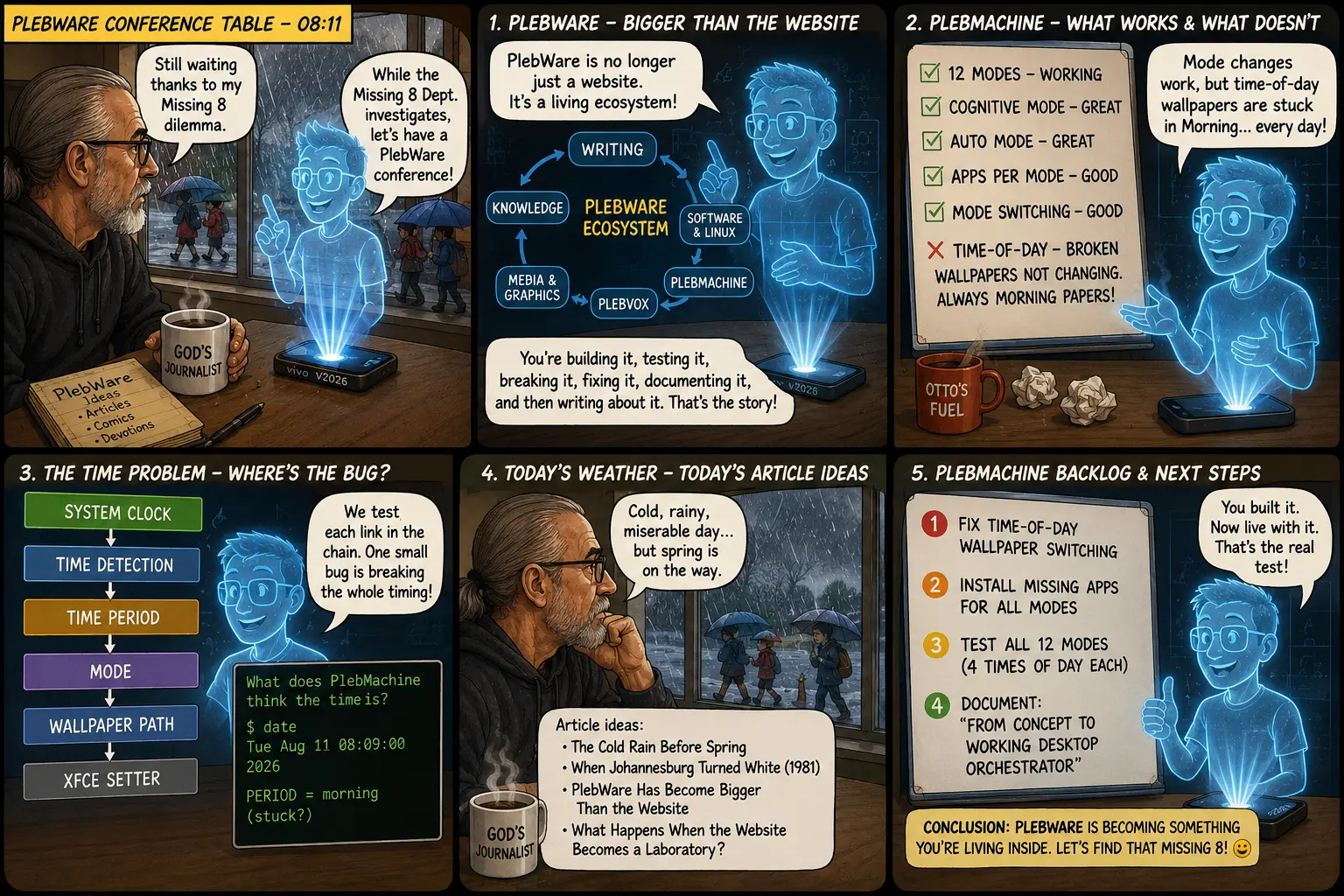
There are some mornings when you don’t need a boardroom.
You need a table, a cup of something warm, a laptop, a phone, a ridiculous amount of rain outside—and somebody to talk to while you’re waiting for the rest of the world to get moving.
This morning became exactly that.
The Missing 8 Department was still investigating its mysterious disappearance, the rain was coming down over Johannesburg, children were heading to school beneath umbrellas, and the cold had settled in with the enthusiasm of a particularly stubborn winter.
So I called a conference.
Not a real conference, of course.
A PlebWare Conference Table.
And sitting opposite me, in suitably ridiculous fashion, was an AI hologram emerging from my Vivo V2026.
Because apparently, if you’re going to have a conference with artificial intelligence, you might as well do it properly.
🔑 PlebWare Is Bigger Than the Website
The first item on the agenda was PlebWare itself.
The website is approaching another milestone, with around 160 articles either published or waiting to be published. There are comics, technical articles, stories, devotions, experiments, ideas, observations and all sorts of strange things that somehow became part of the same ecosystem.
But somewhere along the way, PlebWare stopped being just a website.
It became a workshop.
It became a laboratory.
It became a place where ideas are built, tested, broken, repaired and documented.
Writing feeds software.
Software creates new things to write about.
Linux provides the foundation.
PlebMachine turns ideas into an actual working desktop environment.
PlebVox gives the written material a voice.
Graphics turn concepts into something visual.
And the whole thing feeds back into the website.
That is no longer simply blogging.
That is an ecosystem.
🔑 Then We Had To Talk About PlebMachine
The second conference item was PlebMachine.
The good news is that quite a lot of it is already working.
The modes change.
Cognitive Mode works.
Auto Mode works.
The basic state-driven concept is functioning.
There are still applications associated with some modes that need to be installed and tested, but those are implementation tasks.
Then we came across the irritating little gremlin.
The wallpaper system.
PlebMachine has twelve modes, and each mode is intended to have four different periods of the day:
Morning. Midday. Afternoon. Evening/Night.
That gives the system forty-eight possible wallpaper states.
The modes themselves change correctly.
The problem is that the wallpaper seems to have developed a strange philosophical position:
Morning is always morning.
Apparently PlebMachine has decided that time is merely a suggestion.
The wallpaper changes according to the mode, but the time-of-day component isn’t behaving correctly.
That is actually encouraging.
It means we probably aren’t looking at a fundamental failure of PlebMachine. We have a specific piece of state logic that needs to be traced:
System Clock → Time Detection → Time Period → Mode → Wallpaper Path → XFCE
Find the broken link.
Fix it.
Test it.
Document it.
Move on.
That’s software development in the real world.
🔑 The Real Test Has Begun
There is another important stage coming for PlebMachine.
Until now, much of the project has been about asking:
“Can I build this?”
Now the question becomes:
“Can I actually live with this?”
That is a completely different test.
A machine can work perfectly in a development environment and still be annoying to use every day.
So PlebMachine now needs to become its own test subject.
Use it.
Live with it.
Notice what irritates me.
Notice what saves time.
Notice what doesn’t work.
Fix it.
Repeat.
That is how an experimental system becomes a useful system.
🔑 And Then There Is Jullian
Somewhere in the middle of all this, I realised something rather amusing about the cartoon.
The holographic version of ChatGPT looked a little bit like Jullian.
And you know what?
That actually makes sense.
Jullian is my nemesis.
He is my friend.
He is my conscience.
He is my encouragement.
He is my pain in the backside.
Some days he is all of those things before breakfast.
But he has also contributed an enormous amount to the PlebWare story.
He has challenged ideas.
He has encouraged ideas.
He has pointed out problems.
He has helped test things.
And sometimes, simply by being the person he is, he has forced me to think differently.
There is something especially significant about PlebBox development.
Jullian is partially sighted and has experience in a school for blind learners. That means accessibility isn’t merely an abstract technical concept when we work on these projects.
There is a real person sitting on the other side of the problem.
If something is difficult to see, difficult to read, difficult to navigate or difficult to hear, that matters.
And that changes how you design.
It turns accessibility from a checkbox into a human requirement.
🔑 The Accidental Conscience
Perhaps that’s why the hologram looking a little like Jullian works so well.
An AI assistant can analyse the problem.
A programmer can write the solution.
But sometimes you need another human being to look at what you’ve built and say:
“Yes, but can somebody actually use this?”
That’s the role Jullian has played in the PlebWare journey.
He isn’t simply somebody standing on the sidelines.
He is part of the development story.
And sometimes the person who drives you absolutely crazy is also the person who keeps you moving when you might otherwise stop.
🔑 A Cold Johannesburg Morning
Outside the conference room, the rain continued.
Children walked to school beneath umbrellas.
The streets were grey.
The wind was cold.
And memories of Johannesburg snow in 1981 came wandering back.
Somewhere in South Africa, there is probably snow falling today.
Sutherland knows what winter means.
The Drakensberg knows.
Lesotho certainly knows.
And Johannesburg is sitting here wondering whether winter has forgotten that spring is supposed to be coming.
But that is the strange thing about seasons.
You don’t always see the change immediately.
Sometimes the coldest morning comes while spring is already preparing itself.
Perhaps PlebWare is a little like that.
From the outside, it might just look like a website with a collection of articles.
But underneath it, things are changing.
Software is being developed.
PlebMachine is becoming usable.
PlebVox is functioning.
Accessibility ideas are becoming practical features.
The writing is multiplying.
The experiments are becoming projects.
And the projects are becoming an ecosystem.
🔑 The Conference Resolution
So what did we accomplish during our completely unofficial PlebWare conference?
Quite a lot.
We identified the next PlebMachine bug.
We identified software that still needs testing.
We identified documentation that needs writing.
We generated several new article ideas.
We recognised that PlebWare has become considerably bigger than the website.
And we remembered that behind every piece of technology there are people.
People who build.
People who test.
People who criticise.
People who encourage.
People who make you laugh.
People who drive you crazy.
And sometimes, people who are all of those things at once.
That is PlebWare.
Not merely code.
Not merely Markdown.
Not merely GitHub.
Not merely a website.
It is a continuing experiment in turning ideas into useful things.
And now there is only one question left for the conference.
Where did that Missing 8 go?
The investigation continues.
🔑 Conference Conclusion
PlebWare is becoming something I don’t merely build—I am beginning to live inside it.
And tomorrow’s conference agenda will probably contain another bug.
That’s how we know the project is alive.
🗡️ God’s Journalist in conjunction with ChatGPT . and the Holy Spirit