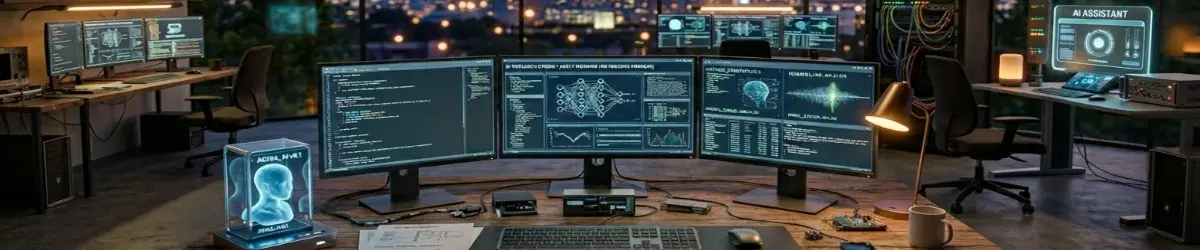
Otto Brinkmeier: The Architect of the Digital Republic
2026-10-14
⚙️ Otto Brinkmeier — The Architect of the Digital Republic
Some people use computers to get things done. Others look at the computer in front of them and ask how the whole experience could work better. Otto Brinkmeier belongs to the second group: a writer, Linux enthusiast, practical problem-solver, and independent builder who keeps turning ideas into projects.
His work brings together a love of open-source software, a determination to keep learning, a writer’s attention to language, and a conviction that technology should remain in service to the human being using it. The projects are varied, but the underlying principle is consistent: make useful things, keep asking questions, and never confuse the tool with the person it is meant to serve.
🐧 The Discipline of the Workbench
Otto’s workshop is the Linux desktop. Working with Linux, particularly MX Linux and the XFCE desktop environment, gives him room to investigate how a computer behaves and how its pieces can be made to work together. He is interested not just in installing software, but in understanding the working environment around it.
That practical approach is central to PlebMachine, his context-aware desktop environment project. PlebMachine is being developed around the idea that a computer should adapt to the kind of work a person is doing. Writing, study, research, graphics, music, video, broadcasting, development, accounting, and leisure do not all ask the same things of a desktop. A useful environment should help the user organise those activities without taking control away from them.
The guiding thought is simple:
Your computer should serve you — not the other way around.
PlebMachine is not meant to hide the computer from its owner or dictate what the owner may do. The user remains in charge and can still launch installed applications. The environment is there to help organise the work, not to make decisions on the user’s behalf.
This is the discipline of the workbench: test an idea, examine what happens, find the mismatch, correct the code, and document the result. The vision may be ambitious, but it still has to work on real equipment and be useful to real people.
✍️ The Keyboard and the Cross
Otto’s identity as a builder is inseparable from his identity as a writer. He develops technical explanations, personal reflections, creative work, and material intended to help other people learn. He continues to write even when circumstances are difficult, and he treats improvement as an ongoing process rather than a finish line.
His creative world includes The Joy Cookery Collection, alongside a range of writing and publishing projects. The collection preserves the spirit of a cookery booklet associated with his mother and brings practical recipes and kitchen guidance to a new generation. It is one example of the way Otto approaches projects: honour what came before, organise it carefully, and make it useful to people today.
His creative identity also includes Othello Cody Verrocchio, while his Christian writing and devotional work are associated with the identity Cody — Dei Scriptor, God’s Journalist. These are different expressions of a person whose interests range from practical technology to literature, faith, and the preservation of useful knowledge.
For Otto, the keyboard is more than a means of producing text. It is a workbench for ideas: a place to document, create, learn, and keep moving forward.
🤝 The Conference Table of Minds
Otto’s approach to artificial intelligence is collaborative. He uses different AI systems as thinking partners for different kinds of work: one may help explore an idea, another may be useful for coding, and another may offer a different reading of a draft. The point is not to hand over authorship or judgement. It is to compare perspectives, ask better questions, test assumptions, and improve the result.
The image of a conference table captures that approach. People and tools may bring different strengths to the discussion, but the human being remains responsible for deciding what is useful, what is accurate, and what should be done next.
This interest connects with Otto’s work on the Sola Verum Protocol and the Content Authenticity Initiative, including questions about attribution, provenance, and how people can better understand the origin and handling of digital content. In a world where generated material is increasingly easy to produce, trust requires care: clear distinctions between evidence and opinion, honest attribution, and a willingness to correct mistakes.
AI can help with the work, but it should not become an unquestioned authority. The conference table is valuable precisely because no single voice should replace the human capacity to think.
🚀 Holding the Line
Building independent projects takes persistence. Progress rarely follows a neat straight line. Hardware can fail, income and time can be limited, and a promising idea may need to be reworked several times before it becomes practical.
Otto’s response is to keep learning and adapting. He has continued developing his projects while dealing with everyday pressures, finding ways to keep working when technology presents unexpected challenges. His determination is not a claim that every obstacle can be overcome immediately. It is the decision to return to the work, make the next useful improvement, and keep the larger purpose in view.
That purpose reaches beyond a single application or article. Through PlebWare, Otto is working toward a connected place for learning, technical projects, writing, creative expression, and shared knowledge. The Plebware HQ Frontier (Now PlebCircle) reflects that community-facing ambition: a place for people and projects to connect rather than remain isolated islands.
There is a personal dimension to this persistence, too. Otto’s bond with his cat Taylor is part of the everyday life that sits alongside the code, the writing, and the plans. A life of building is still a human life, shaped by relationships, responsibilities, setbacks, and small moments of comfort.
⌨️ The Human Being Stays in Charge
The thread connecting Otto’s projects is not technology for its own sake. It is the belief that tools should extend human capability without taking away human responsibility. A desktop environment should help someone organise their work. A website should make knowledge easier to find. A writing project should preserve and share something worth keeping. An AI assistant should support thought, not replace it.
That principle also demands honesty about limitations. Ideas have to be tested. Claims have to be checked. Mistakes need to be corrected. The person using a tool must remain free to question its suggestions and make the final decision.
Otto Brinkmeier is still learning, still writing, still building, and still refining his vision. The work is ongoing, and its value will be measured not only by what gets created, but by whether it genuinely serves people.
The keyboard is mightier than the prompt, and the human being always stays in charge.
🔗 Continue the Conversation
This article has a companion perspective: Otto Brinkmeier and the Human–AI Conference Table. Read both perspectives, then use the return link at the bottom to move between them.
PlebWare — Technology should remain connected to humanity.
Otto Brinkmeier — The Keyboard Is Mightier Than The Pen.