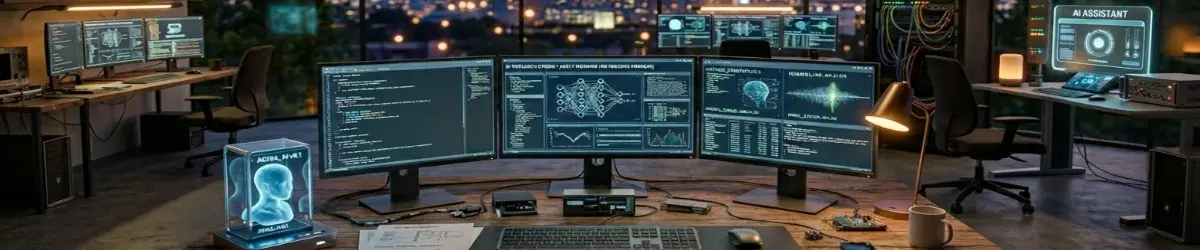
Otto Brinkmeier and the Human–AI Conference Table
2026-10-14
🤖 Otto Brinkmeier — The Man, the Mind, and the Mission.
There is more to a person than what can be seen from the outside. There is the work still being done, the ideas still being developed, the lessons still being learned, and the vision that continues to burn even when circumstances are difficult.
Otto Brinkmeier is a writer, a builder, a lifelong learner, and the person behind PlebWare and PlebMachine. His work brings together technology, writing, practical problem-solving, and a belief that computers should serve people rather than dictate how people must work.
This is a reflection on the man behind the projects: how he thinks, how he works with artificial intelligence, and why the work matters to him.
🧠 An Analytical Mind That Keeps Asking Questions
Otto approaches problems by looking for structure. He wants to know what a system is supposed to do, where its boundaries lie, how its parts fit together, and what happens when one part changes.
He does not simply accept an answer because it sounds confident. He compares it with the problem in front of him, notices when something does not fit, and asks for the work to be corrected.
That habit matters in writing as much as it does in technology. A good idea is only the beginning. It must be examined, shaped, tested, and made clear enough for someone else to understand.
The same curiosity that drives a technical investigation can also drive a conversation about people, faith, creativity, or the way we learn. Different subjects, but the same underlying question: Can we understand this more clearly than we did before?
🐧 Building PlebMachine Around People
PlebMachine reflects one of Otto’s central principles:
Your computer should serve you — not the other way around.
The project explores a context-aware desktop environment that helps people organise their work according to what they are doing. Writing, studying, research, graphics, music, video, and programming can demand different tools and different ways of concentrating.
Rather than treating the computer as the boss, PlebMachine aims to make the working environment more useful to the person using it. The user remains in charge and can still launch installed applications; the system is there to assist, not to take ownership of the decisions.
That philosophy says something about the person building it. Otto is interested not only in what computers can do, but in how technology can become more understandable, practical, and respectful of human agency.
PlebMachine is an evolving project, and its development is part of the learning process. Ideas become specifications. Specifications become code. Code must be checked against the intended behaviour. Documentation helps make the result understandable to someone else.
That is the work of a builder: not merely imagining what might be possible, but returning to the workbench and improving what is there.
✍️ A Writer Who Has Never Stopped Writing
Otto’s work at the computer is not separate from his writing. The two feed one another.
He develops articles, reflections, technical explanations, creative ideas, and material intended to help other people learn. He revises. He listens to drafts. He notices where a sentence does not express what he meant. He keeps working on his own understanding and on the tools that help him communicate it.
Writing is not simply the act of putting words on a page. It is a way of thinking something through.
Sometimes the first version contains the idea but not yet the right expression. Sometimes a conversation reveals a distinction that was difficult to see alone. Sometimes the most useful result is a clearer question rather than an immediate answer.
The willingness to keep revising is a strength. It means the work is not frozen at the point where it first appeared. It can improve.
🤝 Artificial Intelligence at the Conference Table
Otto does not view AI as a substitute for his own thinking. He treats it as a collaborator that can help research, organise, explain, draft, troubleshoot, and explore alternatives.
Different systems can contribute different strengths. One may help plan a structure; another may be useful for coding; another may help shape prose or examine an idea from a different angle. The value is not in pretending that every AI system is the same. It is in understanding the task, choosing a useful approach, and checking the result.
The human still sets the purpose, provides the context, decides what is acceptable, and remains responsible for what is finally used or published.
An AI response can be fluent and still be wrong. Code can look plausible and still fail. A polished paragraph can still miss the writer’s intention. For that reason, collaboration needs feedback, verification, and correction.
Otto’s best work with AI happens when he explains the task clearly, identifies what must remain unchanged, checks what comes back, and keeps refining the result until it fits the real need.
This is not the surrender of thought. It is thought applied to a new kind of working relationship.
💬 The Reality of Working With Other Minds
One of the most important lessons in Otto’s reflections has been this:
“The reality of working with other minds, whether biological or artificial.”
Working with another mind requires more than having an idea and expecting it to be understood perfectly. It requires communication. It requires enough context for the other party to understand the task. It requires patience when the first attempt misses the point, and honesty when a result needs to be corrected.
That applies to human collaboration, too. People bring different experiences, assumptions, strengths, and limitations to a conversation. Misunderstandings can happen even when everyone is trying to help.
The practical lesson is not that every disagreement can be avoided. It is that better communication gives a collaboration a better chance.
Otto has recognised that clearer instructions, more measured responses, and a willingness to pause and refine a conversation can improve the outcome. That is a meaningful form of growth: not abandoning strong opinions, but learning how to express them so that useful work can continue.
A conference table works best when everyone understands the problem being discussed and the purpose of the meeting. The tools and participants may differ, but clarity and respect remain valuable.
🌱 A Learner Still in Motion
A person’s progress cannot always be measured by outward circumstances. Sometimes the visible situation changes slowly while the work happening underneath continues to develop.
Otto continues to learn, write, experiment, and refine his projects. He is willing to revisit decisions, challenge an answer, acknowledge a weakness, and look for a better method. Those habits matter because learning is not a trophy one wins and then puts on a shelf. It is an ongoing practice.
There is also a practical realism in his approach. The tools must work on the equipment available. The ideas must eventually become usable material. The documentation must help a real person. A project must be judged not only by the ambition of its vision, but by the steady work that brings parts of that vision into reality.
Not every day produces a breakthrough. Some days produce a correction, a clearer paragraph, a repaired script, or a better understanding of what should happen next. Those smaller steps are still progress.
The vision remains important. So does the patience to keep building.
🔑 Keeping the Human in Charge
The deeper connection between Otto’s writing and his technology projects is human agency.
A computer should help a person think, create, decide, and act. Artificial intelligence can extend what a person is able to do, but it does not remove the need for judgement, accountability, or care.
That is why the work around the PlebWare conference table is collaborative rather than unquestioning. Ideas are proposed, examined, challenged, tested, and improved. The final decision belongs to the person responsible for the work.
There is room in that approach for confidence without pretending to know everything, ambition without expecting instant results, and correction without treating every mistake as a defeat.
The mission is not simply to build more technology. It is to build useful things while continuing to learn what it means to use technology well.
🚀 The Man, the Mind, and the Mission
Otto Brinkmeier is still working on his vision. He is still improving his skills. He is still writing, still building, and still learning how to turn ideas into something other people can use.
His story is not defined by a claim that everything has already been achieved. It is a story of continued effort: a person bringing decades of experience, curiosity, persistence, and creative ambition to the work in front of him.
The most useful measure is not whether every observer immediately understands the vision. It is whether the work continues to become clearer, more capable, and more useful.
And the guiding principle remains simple:
The computer does not make the decision. It helps you think through the decision.
That is a philosophy for technology, but it is also a philosophy for collaboration. Use the tools. Ask questions. Check the answers. Learn from the process. Keep responsibility where it belongs.
The human remains at the conference table.
🔗 Continue the Conversation
For another perspective on Otto’s work and vision, read Otto Brinkmeier — The Architect of the Digital Republic. The two articles complement one another and can be used to test PlebWare’s contextual return navigation.
PlebWare — Technology should remain connected to humanity.
Otto Brinkmeier — The Keyboard Is Mightier Than The Pen.