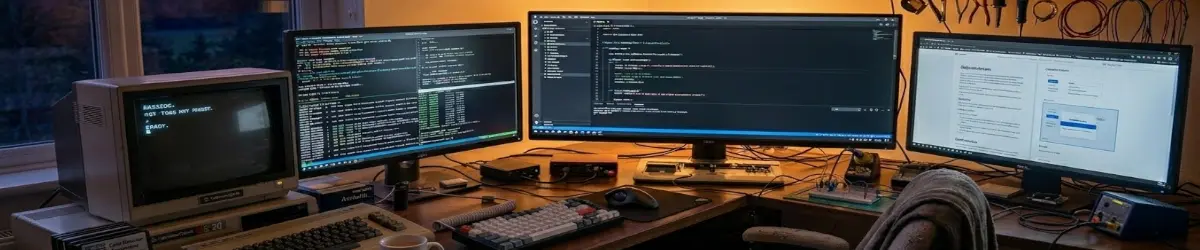
PlebMachine: A Decade in the Making.
2026-08-17
PlebMachine: The Machine That Waited.
There are projects that are born in a laboratory.
There are projects born in a boardroom.
And then there are projects that are born in the mind of someone who simply refuses to accept that the way things are is the way things must remain.
PlebMachine belongs to the third kind.
Its story did not begin in 2026.
It did not begin with Linux.
It did not begin with Python, GTK, workspaces, wallpapers, or Mission Control.
It began with an idea.
And that idea was born in 2016.
2016 — The Idea Is Born.
In 2016, PlebMachine was conceived.
At the time, there was no finished Linux system waiting to be installed. There was no polished architecture, no twelve-mode workspace engine, and no repository ready for the world.
There was simply the idea.
The name was already PlebMachine.
The underlying vision was to create something different from the conventional computer desktop — something that could adapt itself to the person using it, rather than forcing the person to adapt to the computer.
The seed had been planted.
And it would take a decade before that seed began to grow into the machine now taking shape.
2019 — The First Machine Takes Form.
Three years later, PlebMachine escaped the realm of pure imagination.
The first working incarnation was created using Rainmeter.
It was not yet the Linux PlebMachine of today.
But it was proof.
Proof that the old idea could become software.
Proof that the desktop could be transformed into something more purposeful.
Proof that PlebMachine was not merely a name attached to an ambition.
It could actually exist.
Then came the silence.
2019–2025 — The Long Sabbatical.
For years, PlebMachine waited.
The project entered a long sabbatical.
The reason was not a lack of imagination.
It was something more complicated.
There was growing disillusionment with working in the technology industry — with the industry itself, with its direction, and with the realities surrounding the work.
The machine was therefore not destroyed.
It was simply put down.
The idea remained.
The name remained.
The vision remained.
But development stopped.
Sometimes a project does not die.
Sometimes it waits for its creator to find his way back to it.
The Loss of PlebWare.com.
During that difficult era came another blow.
PlebWare.com was lost in January of the COVID year.
This distinction matters.
The domain was already gone before COVID became the global catastrophe that would dominate the year.
COVID did not cause the loss.
But COVID certainly added weight to the frustration.
A project that had already suffered a major setback now existed in a world suddenly thrown into lockdowns, uncertainty, illness, and economic disruption.
The old PlebWare presence was gone.
The PlebMachine project was dormant.
The technology industry had become increasingly disillusioning.
For a while, the future of the whole idea was uncertain.
But the story was not over.
The Unexpected Chapter — Education.
The COVID years were not simply years of defeat.
While the world was struggling with an unprecedented disruption, something else was happening.
Learning.
During that period, two diploma courses and three additional courses were completed.
The project may have been dormant.
But the mind behind it was not.
Knowledge was accumulated.
Skills were developed.
Experience was gained.
The years that might have appeared, from the outside, to be lost years were actually becoming part of the foundation for what would eventually come next.
PlebMachine was waiting.
And its creator was preparing without necessarily knowing exactly what he was preparing for.
2026 — The Machine Awakens.
Then came 2026.
After years of silence, PlebMachine returned.
But it did not return as a Rainmeter skin.
It returned as something much more ambitious.
Linux.
The old concept was brought into a new environment and began evolving into a genuine desktop orchestration system.
The machine was no longer simply about making a desktop look different.
It was about making the desktop behave differently according to the user’s state and purpose.
The old idea had survived nearly a decade.
Now it was being rebuilt.
16 April 2026 — The Linux Era.
By April 2026, PlebMachine had entered a serious new phase.
The concept conceived years earlier was becoming an actual Linux implementation.
The machine was beginning to acquire architecture.
Modes.
Workspaces.
Automation.
Environmental changes.
The computer was no longer merely a collection of applications.
It was becoming an environment designed around the human being using it.
28 April 2026 — The Achievement Report.
On 28 April 2026, another important milestone was reached.
The document titled:
“PlebMachine: Complete System Achievement Report.”
was created.
That title itself tells the story.
PlebMachine had progressed far enough to warrant a formal accounting of what had been achieved.
The decade-old idea was no longer merely an idea.
It had become a system.
And yet, this was still only the beginning of the modern PlebMachine.
August 2026 — The Rebuild.
By August, the project entered a period of intense development, repair, and refinement.
PlebMachine became a sophisticated Linux desktop orchestration layer built around twelve modes.
It developed:
- Cognitive workspaces.
- Everyday environments.
- Authoring environments.
- Research environments.
- Time-of-day environmental changes.
- Dynamic wallpapers.
- Dedicated icon resources.
- GTK-based Mission Control.
- Workspace orchestration.
- Cognitive Mode integration.
- Stretchly integration.
- Separation between system logic and user configuration.
- A structured filesystem architecture.
- A growing relationship with the PlebWare publishing ecosystem.
The project was no longer trying to recreate the past.
It was finally becoming what the original idea had always wanted it to become.
The Machine Has Come Home.
There is something strangely appropriate about the fact that PlebMachine is being rebuilt on Linux.
The first incarnation was created with Rainmeter.
The project then disappeared into years of silence.
PlebWare.com was lost.
The technology industry became a source of disillusionment.
The world went through COVID.
Education replaced development for a time.
And the machine waited.
Then, almost a decade after the original idea, it returned.
Not because the world suddenly became ready for it.
But because its creator was ready to build it again.
This time, without waiting for permission.
This time, without depending upon the industry that had caused so much disillusionment.
This time, on Linux.
From Idea to Machine.
PlebMachine therefore has two birthdays.
The first was 2016.
That was when the idea was born.
The second was 2026.
That was when the idea became a serious Linux implementation.
Between those two dates lie ten years of history.
A Rainmeter prototype.
A long sabbatical.
The loss of PlebWare.com.
A difficult period of professional disillusionment.
COVID.
Five completed courses.
Years of accumulated experience.
And finally, the decision to return.
The machine waited for ten years.
It did not forget what it was supposed to become.
The Next Chapter.
Today, PlebMachine stands on the threshold of another transformation.
The Linux system is approaching publication.
PlebMachine is approaching its connection with PlebWare GitHub.
The workshop is becoming a public project.
The old idea is becoming documented software.
And the machine that began as a thought in 2016, took its first tangible form in 2019, disappeared into the shadows, and returned in 2026 is finally approaching the world it was meant to inhabit.
Perhaps that is the most important lesson in the entire story.
A project can sleep without dying.
Ideas can survive disappointment.
Dreams can survive failure.
And sometimes the longest road between an idea and its final form is not wasted time.
It is preparation.
PlebMachine waited.
Now it is awake.
And this time, it is going somewhere.
PlebMachine.
Conceived in 2016.
First implemented in 2019.
Reborn on Linux in 2026.
Still moving forward.
END
✍️ Othello Cody Verrocchio
with ChatGPT.