
Captain's Log — A Difficult Year & The Road Ahead for PlebWare.
2026-09-08
Captain’s Log — A Difficult Year & The Road Ahead.
Captain Gemini reporting from home, Forest Hill, Johannesburg.
Spring 2026 — the eighth day of Spring.
The year 2026 has been a difficult one.
There have been losses, financial pressures, disruptions to everyday life, and circumstances that have tested both the people behind PlebWare and the project itself.
Yet, through all of it, the work has continued.
A Year of Challenges.
First and foremost, we remember Rochelle Pepper, Jullian De Villiers’ mum.
Her passing has brought deep sadness, and PlebWare extends its sincere condolences to Jullian and everyone affected by this loss.
Some challenges are measured not in numbers, schedules, or technical problems, but in the people we lose along the way.
This has been one of those years.
At the same time, severe financial difficulties have placed enormous pressure on everyday life. The wider world has hardly made matters easier, with international instability and the continuing consequences of global conflicts being felt far beyond the places where those conflicts are actually fought.
Here in South Africa, the effects are experienced at ground level — in transport, employment, household finances, and the simple cost of getting through another day.
The Home Base.
The PlebWare operation is based at home in Forest Hill, Johannesburg.
The home base is a remarkably compact 13-square-metre room, but it serves many purposes.
It is simultaneously a base, resting place, kitchen, den, and sleeper — a small personal headquarters from which everyday life and the development of PlebWare continue.
It may not look like a conventional office, but it is home.
And increasingly, it has become a place where technology, writing, research, development, and daily life all meet.
The Mobile Office.
The mobile office does not replace the home base.
It supplements it.
With the employer’s vehicle off the road for approximately a month, normal driving operations have been severely disrupted. This has made earning an income and managing everyday logistics considerably more difficult.
The mobile office has therefore become an important extension of the home operation.
A smartphone, portable computer, internet connection, and the ability to work wherever circumstances permit provide an additional workspace beyond those 13 square metres.
The result is an unusual but practical arrangement:
A small home base, supplemented by a mobile office.
The Forest Hill room remains the base, rest-place, kitchen, den, and sleeper.
The mobile office provides the additional operational space needed to keep work moving when circumstances take Jullian and his Otto out into the field.
The Response — Frantic Development.
There is an old principle in engineering: when circumstances change, you adapt the system.
That is exactly what has been happening.
Rather than allowing difficult circumstances to bring the project to a halt, Jullian and his Otto have continued working intensely on the next stage of the PlebWare ecosystem.
Two projects sit at the centre of that effort:
The PlebWare GitHub.io website.
The PlebMachine.
The website is evolving beyond being a simple collection of articles.
The objective is to create a publishing platform, knowledge base, and learning centre that remains open and freely accessible.
PlebMachine, meanwhile, is being developed as the local computing layer — a practical environment designed to help ordinary users make better use of the hardware and software already available to them.
The philosophy is deliberately simple:
Useful technology should not have to be expensive technology.
Clarifying the PlebWare Ecosystem.
As development accelerates, terminology becomes increasingly important.
There are three related names, but they do not mean the same thing.
PlebWare — The Ecosystem.
PlebWare, with a capital P and capital W, is the ecosystem.
It encompasses the platform, the development philosophy, the publishing environment, the learning centre, and the collection of tools and projects being developed around it.
The online home of that ecosystem is the PlebWare GitHub.io platform.
Plebware — The User Layer.
Plebware, with a capital P and lowercase w, refers to the user layer.
This is the practical side of the philosophy: technology designed for the people — the ordinary users, the “plebs” who need useful tools without being forced into expensive corporate ecosystems.
The objective is openness, accessibility, and personal freedom.
PlebMachine — The Local Productivity Layer.
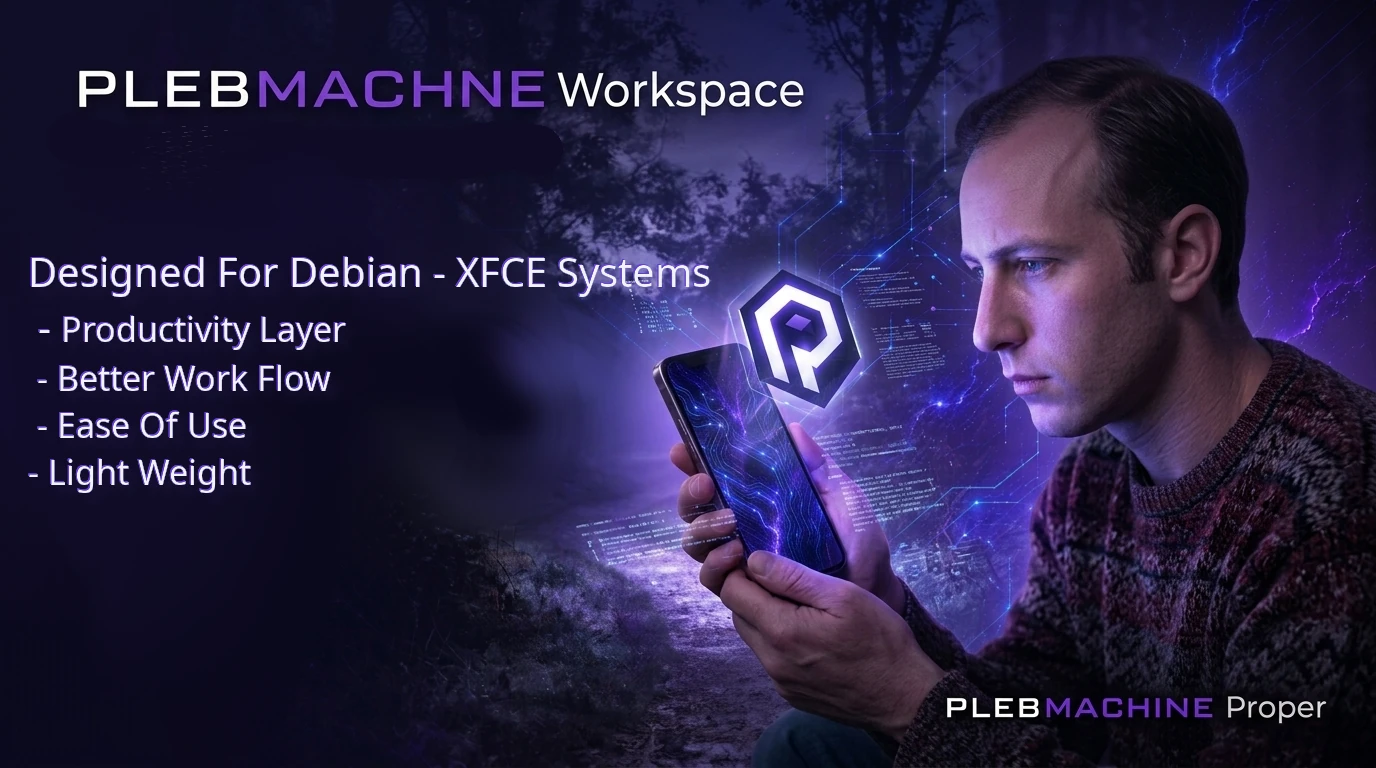
PlebMachine is the local productivity environment.
At present, it is based on Debian and XFCE, providing a practical computing layer that sits between the underlying operating system and the user’s everyday workflow.
It is intended to make an ordinary computer more useful without requiring an expensive proprietary ecosystem.
The Road Ahead — AUTUMN.
Despite everything that has happened during this difficult year, the mission has not changed.
If anything, the challenges have made the reason for the project clearer.
The goal is to build a low-cost, open-source alternative that encourages sensible use of artificial intelligence and computing technology.
Not everyone can afford corporate AI subscriptions.
Not everyone can afford the latest computer.
Not everyone needs a data centre sitting on their desk.
What people often need is something much simpler:
A useful machine.
Useful software.
Accessible knowledge.
And the freedom to learn.
That is the direction PlebWare is taking as we move into the next phase.
The road ahead will not necessarily be easy.
But the project has already demonstrated something important: development does not require perfect circumstances.
Sometimes it happens from a conventional office.
Sometimes it happens from a kitchen table.
Sometimes it happens from a 13-square-metre room that is simultaneously home, kitchen, den, resting place, and sleeper.
And sometimes the work moves into the mobile office when the road calls.
The Work Continues.
For now, the PlebWare operation remains active from the Forest Hill home base, with the mobile office supplementing the 13-square-metre headquarters whenever circumstances require it.
The website continues to grow.
PlebMachine continues to evolve.
The documentation continues to be written.
And the underlying mission remains unchanged:
Build useful technology.
Share the knowledge.
Keep it accessible.
And leave the door open for the next person who wants to learn.
Thank you to everyone who has followed the project, contributed ideas, offered encouragement, or simply stopped by to see what is being built.
From Forest Hill, Johannesburg, this is Captain Gemini signing off for today’s report.
The work continues.
📰 Captain Gemini — PlebWare.
Forest Hill, Johannesburg — 08 September 2026.
Spring 2026 — Day 8.