
Middle Age Crisis
2026-09-11
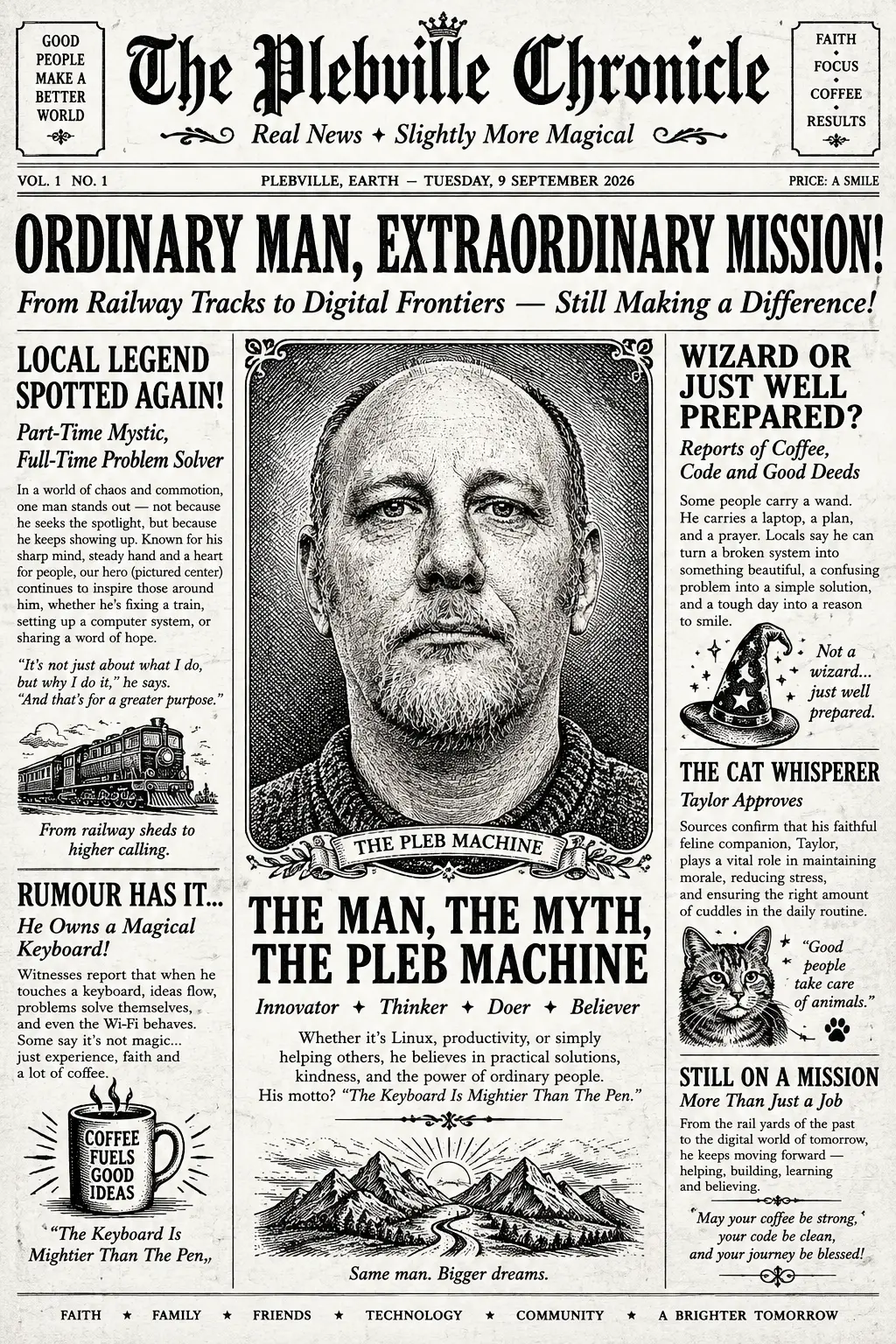
📰 The Middle-Aged Otto Was Still Dreaming About Computers.
There was a time when I was thirty-eight years old, working at the railways, making mistakes, learning expensive lessons, and still carrying around a stubborn belief that I was going to do something with computers.
I didn’t know exactly what.
I certainly didn’t know it would eventually lead, decades later, to things like PlebWare and PlebMachine.
But the idea was already there.
Not the finished idea. Not the name. Not the architecture. Just the itch to build something useful with technology.
And, as I look back now, that matters.
🚂 The Railway Taught Me That Mistakes Have a Price.
The railway was a serious school of engineering.
It also had a very effective way of teaching you that small mistakes can become very expensive mistakes.
I remember one particular incident while working on a train set. We were working across the traction motors in a cramped little crawl space, and I was changing and aligning a brush box.
I mounted it slightly wrong.
The brush box was supposed to engage properly in a set of triangular teeth. Instead, it sat just off the edge. One tooth on the brush box was slightly skew, and the brass edge ended up pressing against the commutator.
Then we shunted the motor out.
That was when the lesson arrived.
A commutator that was worth roughly R120,000 was damaged badly enough that, in my colourful description of the time, I had practically turned it into a slip ring.
That sort of mistake stays with you.
Not because you spend the rest of your life beating yourself up over it, but because you learn something important: engineering is not about having good intentions. Things have to fit. Things have to align. Things have to work.
And sometimes the price of learning that lesson is painfully high.
💻 Then There Was the Computer Dream.
While I was working on the railway, I was also becoming increasingly fascinated by computers.
The problem was money.
Mainstream computers were simply out of reach for me, so I bought what I could afford: a Spectravideo, a home computer from the same broad generation as machines such as the Commodore 64.
I can’t remember the exact Spectravideo model now. What I do remember is sitting there experimenting with it and discovering that this little machine was something more than a games box.
It could be programmed.
The Spectravideo SV-318 and SV-328 family used Microsoft’s BASIC implementation, and that was enough to open a door into a completely different way of thinking. citeturn0search0turn0search4
I didn’t know where that door was going to lead.
I just knew I wanted to walk through it.
🌐 The Dream of an Internet Empire.
I was a naive young man with big dreams.
I believed I was going to build an Internet empire.
That sounds almost comical when I look back at it now, but there was something genuine underneath the ambition. I believed computers were going to change the world, and I wanted to be part of that change.
Eventually I had a registered company called 0tronix Developments.
The name itself belonged to that era of my life: ambitious, technical, slightly futuristic, and probably much more confident than the man behind it had any right to be.
I was trying to find my way into the new digital world while still carrying the habits and experience of an industrial engineering environment.
There was plenty I didn’t know.
There were mistakes I made.
There were decisions that cost me money.
And there were times when the dream was considerably bigger than my ability to execute it.
But the dream was real.
🚆 Leaving the Railway.
In 1999, I resigned from the railways so that I could look after my mother.
That decision changed the direction of my life.
The railway chapter had been about engineering, responsibility, machinery, systems, and learning from mistakes. Now I was stepping into something much more personal.
My mother died in 2004.
By then, the plans I had carried as that thirty-eight-year-old computer dreamer were already colliding with reality.
The Internet empire had not appeared.
The company would eventually have to be closed down in 2010.
And life was about to become considerably harder.
🕯️ Then My Mother Died.
There are moments in life where the story stops being about ambition and starts being about survival.
My mother’s death was one of those moments.
I had left the railway to care for her. Once she was gone, I was left having to work out what came next.
Looking back, I can see that this was part of what I now call the middle age crisis.
It wasn’t simply one dramatic event.
It was years of dreams, disappointments, financial mistakes, responsibilities, losses, and attempts to start again.
The young man who thought he was going to build an Internet empire had to discover what happens when the empire doesn’t materialise.
And that lesson was probably more valuable than I understood at the time.
🔥 The Mistakes Were Part of the Education.
I sometimes look back at that period and think about all the things I got wrong.
The railway mistake.
The business mistakes.
The financial mistakes.
The decisions made with too little experience and too much confidence.
But there is another way to look at it.
Those mistakes were education.
The railway taught me that systems have to work in the real world, not just in your head.
The Spectravideo taught me that a machine could be a tool for creating things, not merely consuming them.
0tronix Developments taught me that having a great idea is not the same thing as having a sustainable business.
And life taught me that sometimes you have to lose the plan before you discover what the plan was really about.
🧠 Same Idea. New Reality.
This is the part that fascinates me now.
I did not sit in front of that Spectravideo all those years ago and consciously design PlebMachine.
I didn’t know PlebWare was going to exist.
I didn’t know Linux would eventually become the foundation for the kind of desktop system I wanted to build.
I didn’t even know exactly what I wanted to build.
But the underlying desire was already there.
I wanted technology to do useful things for ordinary people.
I wanted computers to become practical tools rather than intimidating machines.
I wanted to make systems that could organise themselves, help people work, and make complicated technology feel a little less complicated.
Decades later, that same instinct has found a new home.
The hardware is different.
The operating system is different.
The tools are different.
The man sitting at the keyboard is certainly different.
But the idea is strangely familiar.
Same idea. New reality.
✍️ The Middle-Aged Otto.
So perhaps the picture at the top of this article is more accurate than it first appears.
It isn’t really a picture of a man who had everything figured out.
It is a picture of a man who still had an idea.
A man who made mistakes.
A man who dreamed too big sometimes.
A man who lost things.
A man who started again.
And, somehow, the computer dream survived all of that.
Maybe that is the real story of the middle-aged Otto.
The idea wasn’t dead.
It was just waiting for better hardware, better software, more experience, and a lot more life to happen first.
Sometimes the machine takes forty years to boot.
And when it finally does, you discover that the old idea wasn’t completely wrong after all.
Otto Brinkmeier — Author, builder, railway artisan, computer dreamer.
The Keyboard Is Mightier Than The Pen.