
Golden Years Dreams Come True
2026-09-11
The Dream Is Becoming Reality.
There is something rather strange about looking back at your younger self and realising that the things you once dreamed about are finally beginning to exist.
The eighteen-year-old Otto had ideas.
The middle-aged Otto still had the ideas, but life had become considerably more complicated.
And now there is the old Otto.
Not defeated.
Not finished.
And certainly not ready to put the keyboard down.
The difference is that this time, the dream is no longer merely a dream.
It is becoming reality.
The Morning the Three Ottos Met.
I started working with ChatGPT at around quarter to five this morning.
It is now Friday, 11 September 2026, and I have spent part of the morning looking back at three different versions of myself.
The young Otto.
The middle-aged Otto.
And the Otto who has reached what people politely call his golden years.
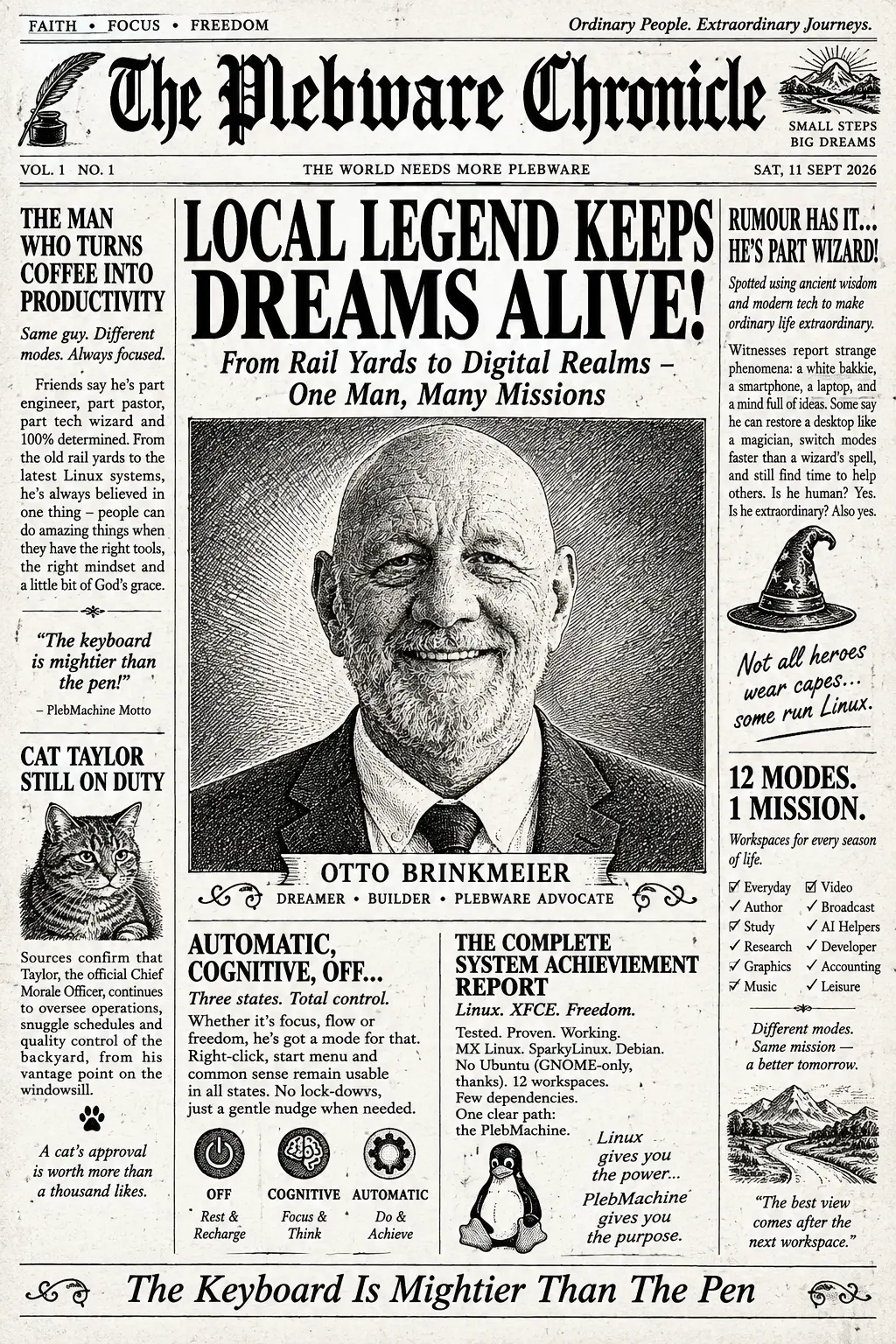
We created three newspaper-style images to accompany those three stories.
Three imaginary newspaper front pages.
Three versions of the same man.
And, in a funny way, three chapters of the same unfinished story.
I then took the images and ran them through an online image-conversion and compression tool. I think it was Squish, although the noise around me here at City Deep Market is making memory rather interesting at the moment.
There are people shouting.
Vehicles moving.
Market noise everywhere.
And somewhere in the middle of all that, I am sitting here writing about dreams that began decades ago.
That seems appropriate.
From Dreams to Something Real.
The biggest difference between the Otto of today and the Otto of eighteen is not that I have stopped dreaming.
It is that I finally have something to show for the dreaming.
PlebWare exists online.
The publishing platform exists.
The articles exist.
The documentation exists.
And PlebMachine exists.
It is no longer merely an idea scribbled somewhere in the back of my mind.
It is out there in the wild.
It runs.
It has been tested.
It has been installed.
And it is still being worked on.
That last part is important.
I am not pretending that PlebMachine is finished.
I am deliberately holding back from promoting it heavily because I want to refine it properly first.
There are things I want to improve.
There is logic I want to modernise.
There are parts of the implementation that need another look.
Some of the older thinking around strings and variables can probably be replaced with cleaner and more modern Bash scripting approaches.
There may still be strings involved.
There may still be variables.
The point is not to chase fashionable terminology.
The point is to make the machine better.
PlebMachine Is No Longer a Dream.
For years, PlebMachine was something I talked about.
Then it became something I designed.
Then something I coded.
Then something I tested.
And now it is something that other people could actually install.
That is a rather significant moment for an old railway artisan who once sat in front of a Commodore VIC-20 and wondered what computers might become.
The machine has changed.
The operating systems have changed.
The programming languages have changed.
The internet has changed.
Artificial intelligence has changed the way we work.
But the basic idea has remained remarkably consistent.
Take complicated technology.
Break it into understandable pieces.
Build something useful.
And make it available to ordinary people.
That is still the dream behind PlebMachine.
And Then Came Artificial Intelligence.
There is another amusing part of this story.
Apparently, we are now having arguments about people using artificial intelligence to help create content.
Google changes things.
Algorithms change.
People discover that something they have been doing for years suddenly makes a website unhappy.
And then everyone starts shouting about AI.
My response is fairly simple.
AI is a tool.
People have been using software tools to improve their writing for years.
Grammarly is a tool.
Spellcheck is a tool.
Grammar correction is a tool.
Search engines are tools.
Word processors are tools.
Even the algorithms deciding what appears in search results are built with increasingly sophisticated forms of machine intelligence.
So I am not going to lose sleep because the internet has entered another phase of figuring out how to deal with AI-assisted work.
Technology changes.
Algorithms change.
The rules change.
Then somebody discovers a better way of doing things.
It will settle down.
Perhaps it will take a month.
Perhaps two.
Perhaps longer.
Who knows?
Frankly, I have more interesting things to do.
I Have Bigger Fish to Fry.
Right now, I am much more interested in PlebMachine.
I am interested in PlebWare.
I am interested in the publishing platform.
I am interested in building something that can survive beyond the person who started it.
That is the part that matters.
I don’t want PlebWare to be remembered as another website that Otto Brinkmeier once played with.
I want it to become something useful.
Something that people can build upon.
Something that can be corrected, improved, expanded and passed forward.
That is why I am taking my time with PlebMachine.
I want to get it right.
Not perfect.
Nothing built by humans is perfect.
And neither is everything made with AI.
After all, AI is prompted by humans. The quality of what comes out is influenced by the quality of what goes in — and humans can make mistakes. Then, of course, there is the occasional AI hallucination, where the machine confidently wanders off into territory that exists nowhere except inside its own generated answer.
So whether it is written by a human, assisted by AI, or generated with AI, it still needs somebody to think about it, check it and take responsibility for it.
The point is not perfection.
The point is to make the machine better.
The Debian Dream.
My eventual target is not one particular Linux distribution.
I want PlebMachine to reach the wider Debian-based community.
That means looking beyond the machine sitting in front of me.
SparkyLinux is part of the testing.
MX Linux is part of the testing.
Other Debian-based systems are being considered.
Xubuntu may be another possibility, although the exact integration requirements still need to be examined.
The principle is simple.
If a system is genuinely Debian-based and provides the environment PlebMachine needs, I want to investigate whether PlebMachine can work there.
That is a much bigger dream than simply getting one installation working on one computer.
It means building something portable.
Something adaptable.
Something that belongs to a community rather than exclusively to its creator.
A Legacy Is Not a Monument.
I have reached the age where the word legacy means something different.
When you are eighteen, legacy is somebody else’s problem.
When you are thirty-eight, you are generally too busy surviving to think about it.
When you reach sixty-three, you begin to understand that time is not an infinite resource.
That does not frighten me.
It focuses me.
I want to leave something behind.
Not a statue.
Not my name carved into a building.
Something much simpler.
Knowledge.
Code.
Stories.
Ideas.
A platform.
A system that somebody else can continue developing.
That is why Julian matters to this story.
I want Julian to be able to continue with PlebWare.
And I want other developers to become involved too.
Actually, let me correct that.
Not maybe other developers.
They are going to.
I am going to make that happen.
The Young Otto Was Not Wrong.
Looking back at the three newspaper Ottos, I think the young man deserves some credit.
He did not know how any of this would happen.
He could not have imagined GitHub.
He could not have imagined Linux distributions running on machines smaller and faster than the computers of his youth.
He certainly could not have imagined sitting in a noisy market in Johannesburg, talking to an artificial intelligence on a mobile phone while building a publishing platform and an operating-system orchestration project.
But he was right about one thing.
Computers were going to become important.
And somewhere along the way, that old curiosity became a dream.
The dream became a project.
The project became PlebWare.
And PlebWare became something real.
So, Is It Too Late?
No.
It is different.
That is not the same thing.
The young Otto wanted to build things because he was fascinated by what computers could do.
The middle-aged Otto wanted to build things but had responsibilities, disappointments, work, money problems and life getting in the way.
The older Otto has something the younger versions did not have.
Perspective.
I know now that a project does not have to be perfect before it becomes worthwhile.
It simply has to become useful.
A dream does not have to arrive exactly as originally imagined.
Sometimes it takes forty years.
Sometimes it arrives wearing a completely different operating system.
Sometimes it arrives with Bash scripts, GitHub repositories, Markdown files and an AI sitting on your phone.
But if it arrives, it still counts.
The Dream Is Becoming Reality.
So here I am.
An old railway artisan.
A pensioner.
An author.
A tinkerer.
A Linux enthusiast.
A man sitting in the middle of City Deep Market while people shout around him.
And somehow, after all these years, I can finally say something that the eighteen-year-old Otto could only imagine.
I created something.
Not just an idea.
Not just a plan.
Not just a notebook full of possibilities.
Something online.
Something functional.
Something that other people can see.
Something that other people can eventually use.
Something that can continue after I am gone.
That is worth more to me than worrying about whatever Google’s next algorithm happens to do.
The algorithms will change.
The technology will change.
The arguments about AI will change.
But a useful idea can survive all of that.
And that is what I intend to build.
The Story Continues.
This is not the final chapter.
Far from it.
PlebWare still has work to do.
PlebMachine still has work to do.
The publishing platform still has work to do.
There are bugs to find.
Ideas to test.
Code to simplify.
Documentation to improve.
And eventually, developers to bring into the project.
That is the exciting part.
The old dream is not ending.
It is becoming a living project.
Perhaps that is the greatest lesson of all.
Sometimes we think a dream has died simply because it took too long.
It hasn’t.
Sometimes it was just waiting for us to become capable of building it.
From One Otto to the Next.
The eighteen-year-old Otto dreamed.
The thirty-eight-year-old Otto struggled.
The sixty-three-year-old Otto is building.
And somewhere between those three men is the story of a life that refused to give up on an idea.
So no.
It is not too late.
The dream is becoming reality.
And this time, I intend to see it through.
PlebWare is now part of that legacy, and the work can continue to grow beyond the man who first imagined it.
Technology should remain connected to humanity, and sometimes the keyboard really is mightier than the pen.
💬 Your Thoughts.
Have you ever had a dream that you thought was too late to pursue?
Perhaps you started something when you were young and life got in the way.
Perhaps you thought the opportunity had passed.
Perhaps you simply needed forty years to discover what the dream was really supposed to become.
If so, I would love to hear about it.
Sometimes the most interesting stories are the ones that took the longest to arrive.
💬 Comments