
PlebMachine and the Three AI Assistants.
2026-09-02
🤖 PlebMachine and the Three AI Assistants
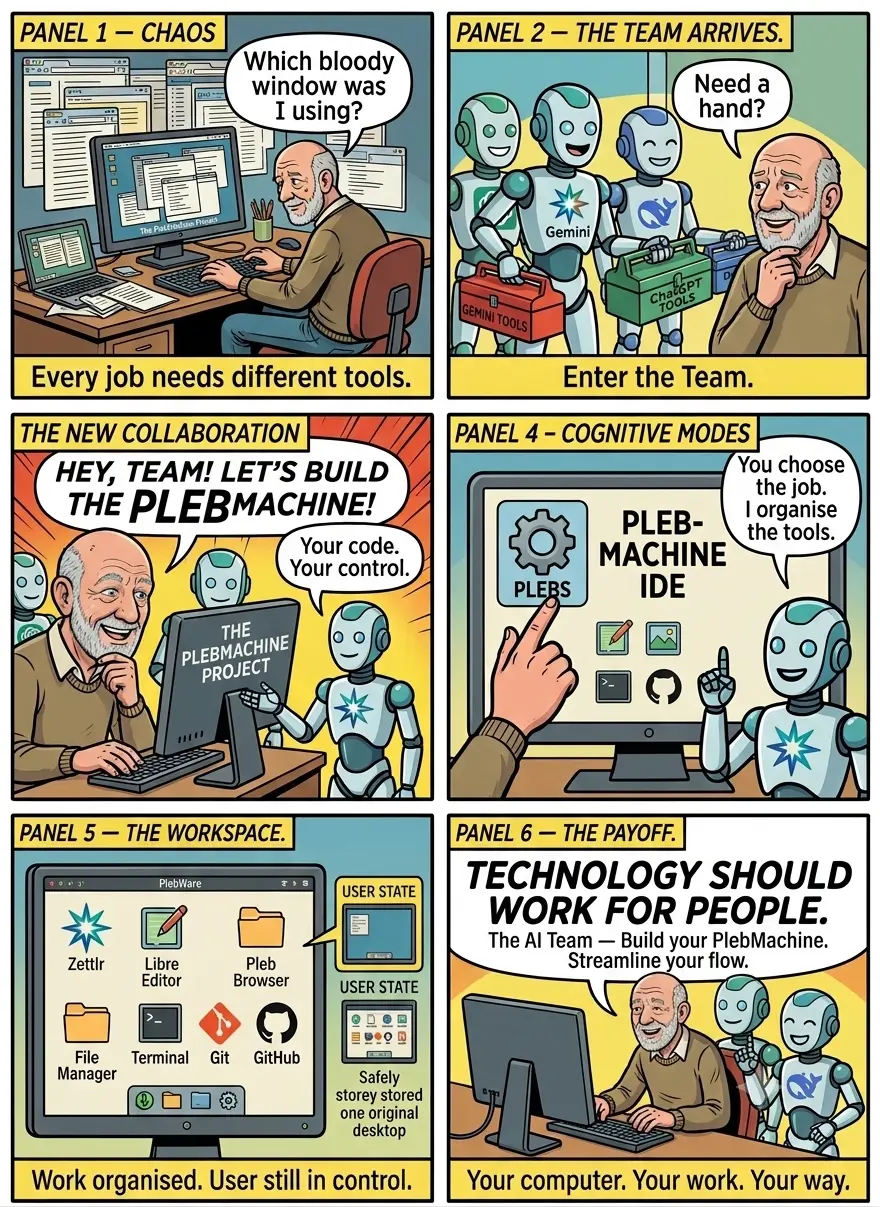
It Takes a Village to Build a Machine.
PlebMachine looks like a modern project, and in many ways it is.
But its story goes much further back than the arrival of today’s artificial intelligence assistants.
Otto has been writing code since his Commodore 20 days, spending hours and hours turning ideas into working programs.
The First Decision Machine.
One of those early programs was written to help Otto make decisions.
It worked with variables displayed on a screen. Information went in, the program processed those variables, and the result helped Otto decide what to do.
It was a small program compared with PlebMachine, but the fundamental idea was already there: use a computer to assist human reasoning and decision-making.
PlebMachine Is a Glorified Extension.
In that sense, PlebMachine is a glorified extension of that old idea.
The original program dealt with variables on a screen.
PlebMachine deals with the state of an entire Linux desktop: working environments, applications, workspaces, configuration and the user’s requirements.
The scale is vastly different, but the underlying relationship is surprisingly similar.
From Variables to Cognitive Modes.
The old program worked with variables.
PlebMachine works with states, modes, applications, workspaces, configuration and user requirements.
The computer takes information, processes it according to rules, and produces a useful result.
The old program helped with a decision on a screen. PlebMachine helps organise a working environment around the person using it.
Then Came the Long Hours of Coding.
Before AI assistants entered the picture, Otto had already spent hours and hours writing code.
Those years taught him the fundamentals: logic, variables, processes, inputs, outputs, debugging and the importance of testing what you actually build.
That experience became part of the foundation for working with much more powerful tools later on.
Enter the AI Assistants.
Then came the three little robots: ChatGPT, Gemini and DeepSeek.
They became assistants in the development process, helping with architecture, code, troubleshooting, explanations, alternatives and the endless process of asking, “Why the hell isn’t that working?”
But they joined a development process that already existed.
Three Little Robots. One Experienced Human.
The comic shows Otto surrounded by code windows, with ChatGPT, Gemini and DeepSeek looking on like three tiny robotic assistants.
And Otto is still asking the question that every computer user eventually asks:
“Now where’s that window?”
AI Doesn’t Build the Machine by Itself.
AI can suggest code.
It can explain errors, propose architectures, rewrite functions, compare approaches and provide another perspective.
But somebody still has to understand the goal, decide what makes sense, test the result, reject bad ideas and install the working system on real hardware.
That somebody is Otto.
The AI assistants are tools and collaborators in the process, not autonomous replacements for the person building PlebMachine.
The Old Idea Meets the New Technology.
There is something rather satisfying about the connection.
A young programmer on a Commodore 20 wrote a program that used variables on a screen to help him make decisions.
Decades later, that same programmer is working on PlebMachine, using a far more sophisticated system of states, modes and environments to organise a Linux desktop.
The technology changed dramatically.
The fundamental idea did not.
The computer is still being used to help organise information and support human thinking.
From Ideas to a Working Machine.
The development process is a mixture of conversation, coding, testing and iteration.
Otto describes the problem. An AI assistant suggests an approach. Code is written. The code is tested. Something breaks. The problem is investigated. The code is changed. Then it is tested again.
That cycle is repeated until the machine does what it is supposed to do.
The Real Innovation Was the Partnership.
AI did not make programming possible for Otto.
He had already been programming for decades.
What AI changed was the speed and scale at which ideas could be explored, questioned, explained and refined.
The old programmer is still there.
The toolbox simply became much more powerful.
And Then There Were Windows.
There is a terminal window.
There is an editor window.
There are AI conversations, documentation, tests, configuration files and probably several windows that Otto opened five minutes ago and has already forgotten about.
And somewhere in the middle of all that modern computing power comes the timeless cry of the programmer:
“Now where’s that bloody window?”
From the Author’s Desk.
PlebMachine may be a modern, AI-assisted Linux desktop orchestration system, but its roots reach back decades.
The Commodore 20 decision program and PlebMachine are separated by enormous changes in technology, yet they share a fundamental idea: use computing to help organise information and support human decision-making.
Today there are three little AI robots helping with the work.
ChatGPT.
Gemini.
DeepSeek.
They are useful assistants.
But there is still one experienced human sitting in the middle of the code, making the decisions, testing the machine and occasionally wondering where he put that window.
PlebWare — Technology should remain connected to humanity.
Otto — The Keyboard Is Mightier Than The Pen.
Juelz — Christ Above All • Music from the Heart • Games with Honour